
On Eldership, Stewardship, Legacy.
Reflections from the Brown Book by Brian Kennedy II

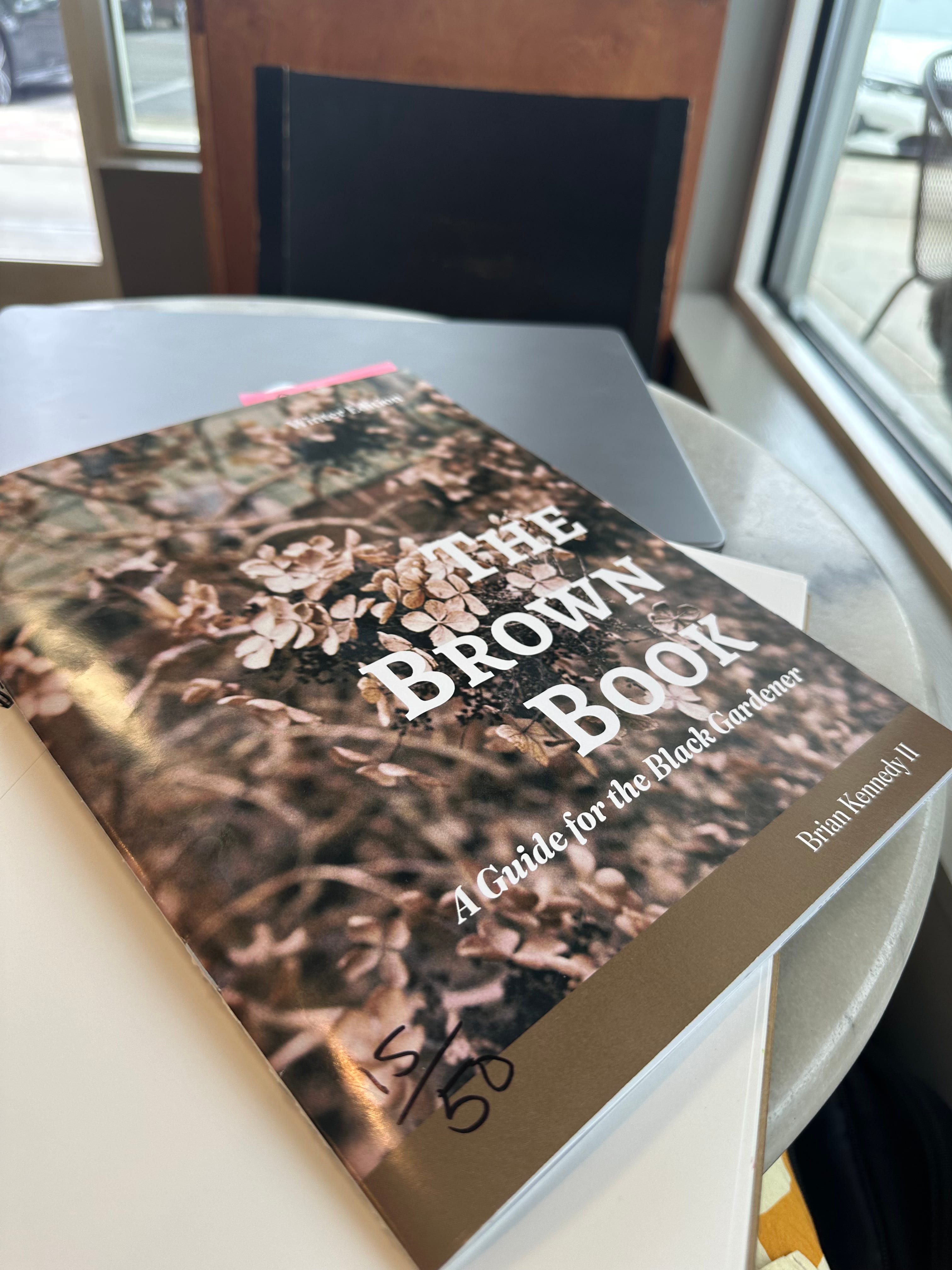
Last month, I was blessed to receive copy 15/50 of the Brown Book: A Guide for the Black Gardener by Brian Kennedy II. Funny enough, I have had conversations with him about it and I still somehow forgot that a part of my contribution to the Kickstarter meant I’d get a signed copy LOL. I’m just tired and I blame Dr. Umar. Either way, I picked it up, took my commemorative photo of it, and put it on my nightstand. Because I read right before bed, I knew it was what I’d need each evening to ease me into sleep. But here’s the thing, I picked it up, read this beautiful, moving, spiritual opening called “On Conversations with the Soil”. Gotdxmn Brian. “I Am the soil-maker.” Sheesh.
So, I keep reading. Intro. All bars. Brotha Elder Marcellous Taylor, Sr. from Beltsville Maryland. Sound like a place where you might stumble upon a old fashion ass-whoopin. Then to sista Mia Kennedy, a gardener and maker who we had the privilege of hearing about her journey at Swamp Jam II to close out Brian and I’s Grounded Possibilities fellowship. But let me get to the point: In my last acupuncture appointment I was explaining what is happening in my life. From crisis to stress to new health challenges to attend to, to relationship support for friends in disrepair—and she simply, gently, asked, “Who are your elders?”
Had I paused for a second too long I might’ve shed a thug tear. The question shocked me because as a old YN, I find myself in elder-ish position in my own relationships. Being asked for and giving [usually] solicited advice or sharing gems from what feels like an ancestral place. For me, this eldership is not something I take lightly, and it is not without intense mental, emotional and spiritual weight. Not only that, but there are few folks in my life that I can actively seek advice from, aside from folks I won’t name here but they know who they are. The other shock of the question sits in the reality that those I’d want to name as my on call elders are gone. At least their bodies have transitioned into the Dirt that Brian references. And this is something I am doing my homework on.
Furthermore, the Brown Book is a generous and timely gift from which I drew a clear message: We are all stewards of and tending to something. Ourselves, our bodies, relationships, children, family, new practices, faith, dirt, plants, animals. The list goes on. And through that tending, we plant seeds that will produce a future that we are actively involved in creating.
In our daily actions, prayers and processes we invest effort, energy and time into co-creating with others and with this World. The Brown Book crafts a clear vision of what that could look like. AND that it can be found in eldership of and with others. I’m coming to the see all of the ways that those with experiences and wisdom are already elders. Meaning, each of us are already the elders that we think we will suddenly become when we’re 50+. Eldership is not the destination, but the series of steps to get there. In the book, Brian interviews intergenerational Black gardeners about more than how to grow a thing. If that was the ask, the book would be one page and maybe just a DIY checklist. It could be quick. It could be microwavable TikTok content. Growing a thing can be very technical. Yet, stewarding a garden is a totally different experience. It brings us to our senses, figuratively and literally, and dares us to chill tf out, tend, pay attention, to be present everyday. And teaches us not to be a helicopter gardener but to put your trust in the process of growth, of time, of darkness, of the natural elements to bring life and fruit into the world.
“If you watch it grow, it’s gone grow slow. If you leave it ‘lone it’ll grow on its own” — Somebody in the spirit world (as I was standing in my own backyard garden staring at my okra plant, wondering when pods would start.)
But that is not what capitalism/imperialism invites. It invites control, domination, extraction, acceleration, bending land and its’ elements to your will so that you can grow okra in Antartica. The Brown Book, for me, challenges one to look into their life for the things that we are tending to or, more honestly, the things that we are not. What has overgrown? What grows limp from lack of watering? What needs to be drawn out and moved closer to the light? What needs to be pruned so it can grow? What is yielding abundant fruit with little attention or awareness? And in the times I need to rely on the wisdom of others, there is now a Brown Book to remind me that stewardship is a life-long journey with many seasons.
Thankfully, there are others who have likely planted, grown, failed, harvested in similar seasons. Thankfully stewards usually want to share their wisdom. I ain’t met one that didn’t. Thankfully, thankfully, thankfully Brian has inspired me/us to ask questions and to steward too. That is legacy. That is the gift of the Brown Book. Brian clearly knew this. Because there is not a single photo of him in the book, except for one single image of his hand at harvest, and except images of his kids. Which really, I guess, is the same thing.
Ase.

